Cool Ethics vs Warm Love – Jane Eyre

Barriers to True Love
(I fear that this post will have too many words…)
What works in a relationship is unique to the individuals. Security, a family, social standing may be important. Morals, ethics and values may be important. Fundamentally success depends on how they each deliver what the other needs. And most important is the fundamental connection between the couple. Love is often used to describe this connection…but love is open to interpretation (see below). I understand it to be broadly acknowledged that a fundamental part of love is that both give and receive what is needed by each to grow and be happy. Even though this giving and taking may ebb and flow throughout the relationship, most assume that a healthy relationship requires that, over a longer period, the giving and taking is balanced between each other. Whilst each is responsible for their own happiness, this happiness can be magnified in a loving and positive relationship.
Novels such as Pride and Prejudice by Jane Austen show how anxieties about social connections, or the desire for better social connections, interfere with the workings of love. Austen views love as something independent of these social forces, as something that can be captured if only an individual is able to escape the warping effects of a hierarchical society. This has become to be a commonly accepted view today.
Love therefore is at its best when not warped by societal anxieties but wholly focussed on the nurturing of the couple. As is stated in the Bible 1 Corinthians 13, love is many things. Here is an excerpt:
…Love is patient, love is kind. It does not envy, it does not boast, it is not proud. It does not dishonour others, it is not self-seeking, it is not easily angered, it keeps no record of wrongs. Love does not delight in evil but rejoices with the truth. It always protects, always trusts, always hopes, always perseveres….
The Bible requires many verses and many attributes to try to describe love. This ideally is too many. But once one has experienced love over a longer period one understands that love does indeed have many attributes and that it is difficult to succinctly describe them all.
This post can only focus on a limited area. It considers that there is the need for love to be nurturing, to be active (not passive), to be kind and for resentments not to be harboured.
Problems arise if there is an unresolved fundamental disagreement between the two and leading to harboured & hidden resentments. One or both persons, whilst continuing to be basically sociable and pleasant, may have consciously or unconsciously withdrawn from the relationship. They have decided to be passive as a means of punishing the other or at the very least to help process their own anger or hurt. These are barriers to true love. This love is not nurturing or kind. Resentments are harboured leading to a passive not active love which is insufficient and in time may destroy the relationship.
Jane Eyre will not accept a Loveless Marriage to St.John Rivers
In the novel Jane Eyre she describes how a marriage lacking active and nurturing love would kill her. A dramatic mode of expression (and indeed St John Rivers described it as violent and unfeminine (it was not)) but it certainly communicates to me the strength of her feelings and the clarity with which she sees her needs and her rationale for her actions.
As a context : Jane falls in love with a man called Edward Rochester who also falls in love with Jane. Both have a passionate and direct nature, hers is more latent (she is much younger) but this is developed throughout the novel. But she finds out (on the altar) that he is married already and therefore she decides that she must leave him. She is now penniless and is lucky to be rescued from destitution by a man called St. John Rivers (and his two sisters). She develops a pleasant relationship with him and when in time she finds out that they are cousins the relationship becomes one of sisterly and brotherly love (she shares her inherited fortune with him and his two sisters). But he wants more. He wants her to marry him and become his partner as they travel to India as Christian missionaries. But he does not love her as she would wish a husband to love her. She has had a taste of “real love” with Rochester who though flawed in the eyes of society and her own morality demonstrated an ability to allow her to be free, to grow and to become a better version of herself. He was also passionate and warm which Jane also discovered that she needed. His love was warm and nurturing.
St. John isn’t just Jane’s antagonist because he wants her to marry him and she’s not interested; he’s also an extreme version of what Jane has been trying to become—a dispassionate, rational person guided only by calm consideration of morality and ethics. Jane has to reject him and embrace her own passionate nature before she can marry Rochester.
Jane rejects Rochester’s illicit passion and his attempt to commit bigamy and/or make her his mistress, but she’s even more appalled by St. John’s desire to make her his legal wife and sexual partner without love or passion. St. John may be more correct in the eyes of the law and the Lord, but the demands he makes of Jane are much more disgusting than Rochester’s in her opinion. Jane goes back to Rochester not because she knows he’s single now but because she’s got to get away from St. John.
Jane Eyre Chapter 35 – A Marriage lacking Nurturing Love would Kill her
See what is said in Chapter 35 near the end of the Novel.
…During that time he made me feel what severe punishment a good yet stern, a
conscientious yet implacable man can inflict on one who has offended him. Without one overt act of hostility, one upbraiding word, he contrived to impress me momently with the conviction that I was put beyond the pale of his favour.Not that he harboured a spirit of unchristian vindictiveness–not that he would have injured a hair of my head, if it had been fully in his power to do so. Both by nature and principle, he was superior to the mean gratification of vengeance: he had forgiven me for saying I scorned him and his love, but he had not forgotten the words; and as long as he and I lived he never would forget them. I saw by his look, when he turned to me, that they were always written on the air between me and him; whenever I spoke, they sounded in my voice to his ear, and their echo toned every answer he gave me.
He did not abstain from conversing with me: But to me, he was in reality become no longer flesh, but marble; his eye was a cold, bright, blue gem; his tongue a speaking instrument–nothing more.
All this was torture to me–refined, lingering torture. It kept up a slow fire of indignation and a trembling trouble of grief, which harassed and crushed me altogether. I felt how–if I were his wife,
this good man, pure as the deep sunless source, could soon kill me, without drawing from my veins a single drop of blood, or receiving on his own crystal conscience the faintest stain of crime.He experienced no suffering from estrangement–no yearning after reconciliation; and though, more than once, my fast falling tears blistered the page over which we both bent, they produced no more effect on him than if his heart had been really a matter of stone or metal. To his sisters, meantime, he was somewhat kinder than usual: as if afraid that mere coldness would not sufficiently convince me how completely I was banished and banned, he added the force of contrast; and this I am sure he did not by force, but on principle.
Ask for what you Need…Positively
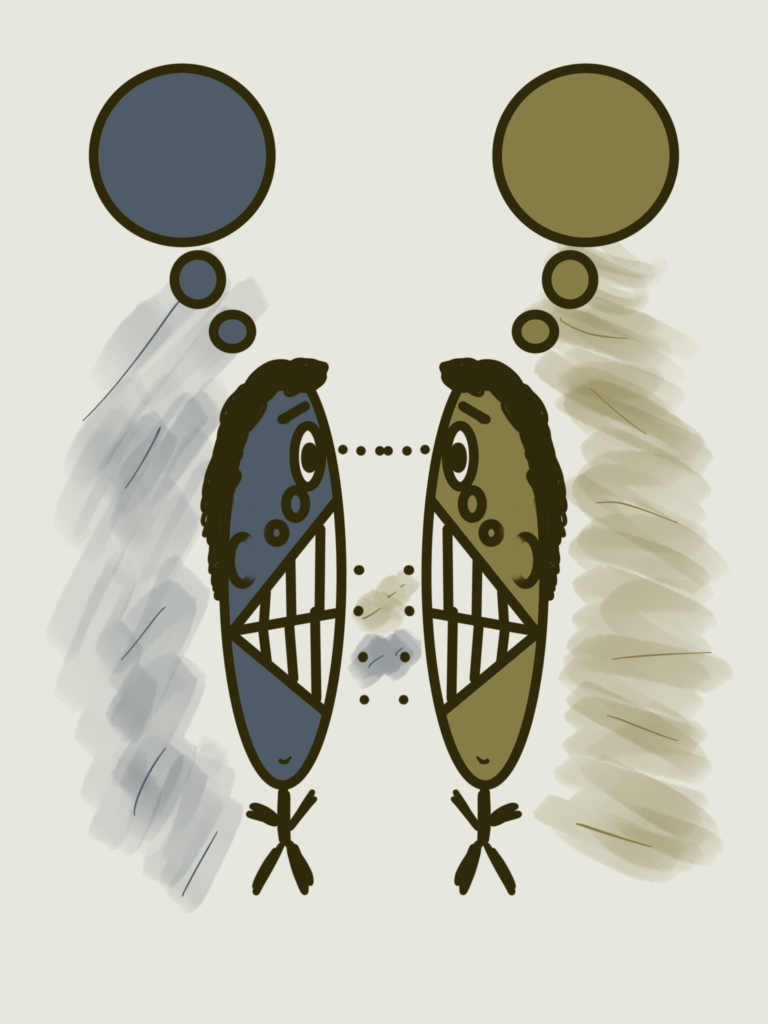
Asking for what you need is harder than it sounds.
“It can be nerve-wracking to be so vulnerable – even with your partner”. “It can feel scary. If you ask someone for something there’s a chance they’ll say no. At some point in our lives, we’ve all been shut down.”
Having our requests ignored can often result in us believing we aren’t worthy of having our needs met or that our needs are bad.
Going forward, instead of being clear about what we require we simply allude to it and pray our partners will catch on. This is where disappointment and resentment seep in because your partner is not a mind reader.
A better way to get what you want is to simply ask, in a straightforward, non-accusatory way.
Use these 3 steps to ask for what you need
If you have trouble expressing your needs, following these three steps may help.
Step 1: Reflect
“Take a moment, right now, and think about what you’ve been wanting from your partner,” they write.
Is it more date nights? Or more help around the house? Just being listened to?
Step 2: Reframe
“If you are thinking in a negative perspective, flip it,” they write. “Don’t point out what’s wrong. Offer an opportunity.”
What positive action can your partner take to fulfill this need?
Step 3: Describe yourself
“Always ask for what you need by talking about how you feel and what you need,” they write.
If you want more date nights, instead of saying “You never take me on dates anymore,” say “I miss you. Can we plan to have more one-on-one date nights this month?”
If you need more help around the house, don’t say “You always go to bed before the dishes are done.” Instead, say “I’ve been feeling super swamped lately. Would you be able to help me out with the dishes before bed?”
If your relationship is prone to a pattern of criticism, the other person might read anything you say as negative. But if you continue to speak with your partner from a place of positivity, a shift will occur and they might start feeling less attacked and more receptive.
You can also try to ask for needs that aren’t “corrective,” but are acts that will make you happy.
For example, you can ask them to make you a cocktail you both enjoy or to stop by your favorite bakery for a snack you both can eat together.
“Make a sweet request that they can easily fulfill,” they write. “So you can genuinely say ‘Thank you! That felt great!’”
For more on this topic see this article.
(Tips can help. But relationships are hard work and need love and laughter as the fundamental fuel to keep them going.)
” Listen, Connect, Be There, Turn Toward”
Different language is used to say much the same thing. It may be Listen to each other, Connect with each other, Be there for each other or a new one to me…Turn towards each other. Taken from an article I came across it does explain a key part of relationships.
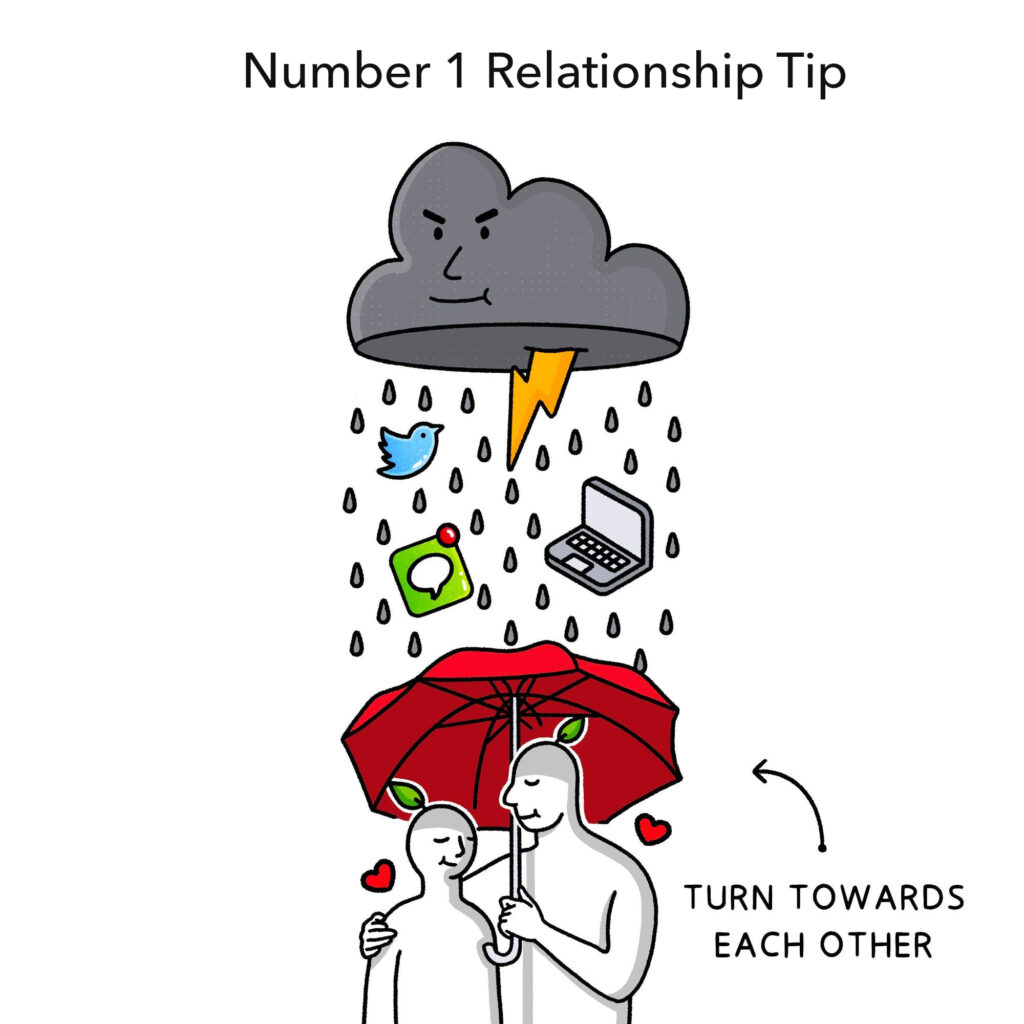
When a couple turns toward each other, they make and respond to what we call “bids for connection.” Bids can range from little things, like trying to catch your attention by calling out your name, to big things, like asking for deeper needs to be met.
The happiest couples are savvy enough to notice when their partner is making a bid, and drop what they’re doing, if necessary, to engage.
Here’s an example: Your partner, scrolling their phone, remarks, “Oh, this is an interesting article.” (This is a bid for connection.)
You can respond in one of three ways:
- By turning toward – Acknowledging them and engaging with their attempt to connect: “Oh yeah? What’s it about?”
- By turning away – Actively ignoring or just not noticing their attempt to connect: You keep typing the email you’re working on while staring at your screen.
- By turning against – Irritably or angrily shutting down their attempt to connect: “Can’t you see I’m trying to work?”
The act of turning toward builds affection and a sense of teamwork, which helps strengthen the foundation of a lasting relationship.
Of course, it’s impossible to always turn toward your partner. But in our lab study, the couples who stayed together for at least six years turned toward each other 86% of the time. Those who got divorced only did it 33% of the time.
Read more about this topic in this article.
(Tips can help. But relationships are hard work and need love and laughter as the fundamental fuel to keep them going.)
Dashboard
UK FTSE100 vs UK 10Y Bond Rate
source: tradingeconomics.com
UK FTSE100 vs US30
source: tradingeconomics.com
UK vs UK Inflation Rate
source: tradingeconomics.com
OECD G7 Business Confidence Index
Composite PMI
source: tradingeconomics.com
Corporate Profits UK & UK
source: tradingeconomics.com
UK Real Pay Growth 2000-2022
The Average Real (after inflation) Total Pay for the whole economy has basically stayed flat (2.4% growth in 14 years) since 2008. This has been calculated using the Real Earnings -Average Weekly Earnings annual growth rates – real pay chart and links below from the ONS.
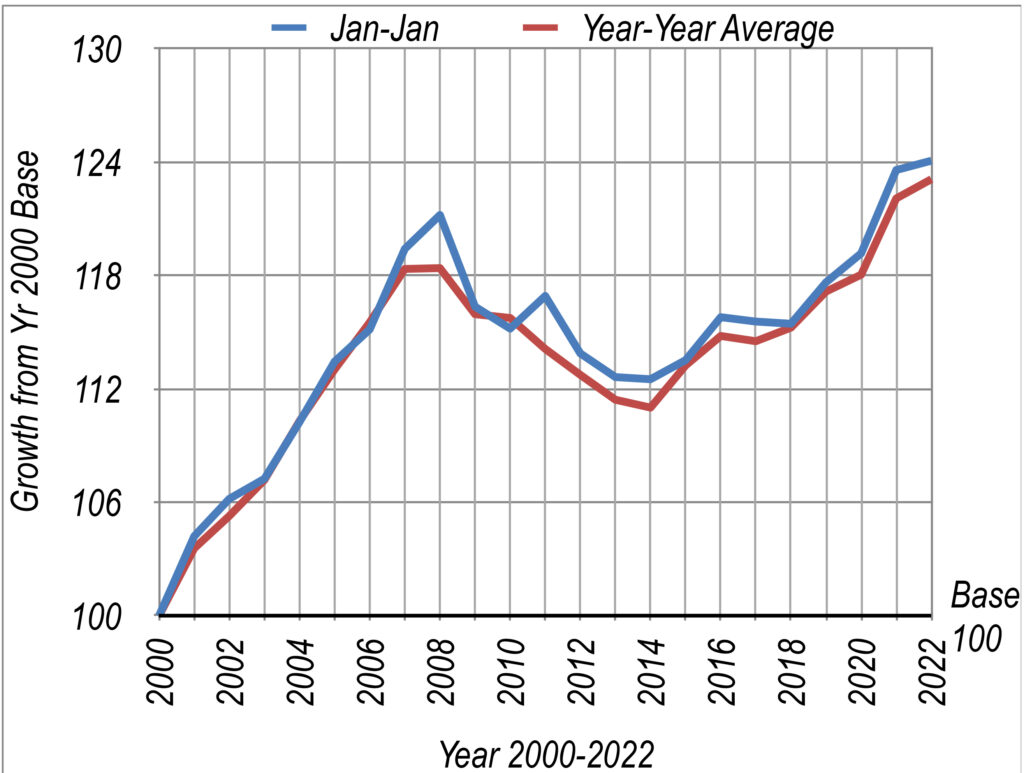
It is fair to say that there are certain sectors that have done better (eg Finance) and certain that have done worse (e.g Public Sector). More details on the ONS website.
UK Labour Market Overview October 2022
Truth

The Truth – I thought I Understood it
There is much debate, much argument, much competition and much conflict to determine what is the “truth”. The “truth” is a word that is used so much and is so commonplace that we often do not ask what it means. I did ask recently and I found that it is more complex than it appears. I now believe that a better understanding of the nature of truth is key to better communication and achieving better human connections.
Dropping a Ball – The Correspondence Theory of Truth
The Correspondence theory of Truth is the theory that best reflects the common understanding of Truth. That is that a proposition or belief is true if it is demonstrated to correspond to a view of reality that can be demonstrated or which is generally accepted as corresponding to reality based on previous experience. In the most simple and most powerful case this can be self verified through demonstration. But even if it cannot be self verified it may correspond with an existing world view.
Let’s look at the following proposition:-
a ball dropped from a higher position will fall to a lower position.
Most people would agree that this is true because:-
- They can self verify by doing an experiment that shows that this is true.
- It corresponds with their Worldview (their internal representation of reality). They will have experienced that something dropped from a height falls to the ground and will have never experienced this truth being contradicted
But…even this simple example poses questions:-
- What is reality? Is our perception of it the same as that of others? All observation is from a point of view and coloured by conditioning and understanding.
- Karl Popper believed that all (scientific) knowledge is provisional – the best we can do at the moment. Therefore something is true until something better comes along. For instances all agreed at one time the proposition “ All swans are white” to be true until a black swan was discovered which falsified that proposition and showed it to be untrue.
- The proposition itself is based on language, culture and context. It would normally be assumed that the ball was dropped on Planet Earth and not Space (for instance).
- What about hypothetical propositions (If we do x then y will happen)? How may they be verified such that they are shown as corresponding with the real world?
Dropping a Ball in Space – The Coherence Theory of Truth
Let’s change the context. Let’s assume we are in space. Let’s look at the following proposition(2).
a ball dropped from a higher position will fall to a lower position (in Space).
Most people now would agree that this proposition is untrue. But why?
They cannot immediately self verify or demonstrate that it is untrue. They have never been to space and so have never personally observed what happens there. But, they have seen Space in multiple films, documentaries, have heard stories told by those who have been to Space, have listened to trusted experts who have all agreed with the story that would falsify the above statement.
In short they created a belief that became part of their Worldview. This belief is that in Space:-
a ball dropped from a higher position will not fall to a lower position.
Instead, it will float.
So while a ball floating in space cannot be self verified or easily demonstrated it is part of the world view of many and therefore the above proposition(2) is not coherent with the Worldview of such individuals. This is an example of the Coherence Theory of Truth whereby something is considered true if it is Coherent with an existing world view. (This is best seen as a complementary to the Correspondence Theory of Truth). It connects most directly with idea that reality is only known through our mental representation of it.
It shows the power of stories and imagination in the creation of a representation of reality and how individuals can be influenced by others through propaganda to create a Worldview that may not in fact correspond with objective reality.
But… this also poses more questions:-
- It is possible for an event or statement to be coherent with different Worldviews.
- It is possible for an event or statement to be coherent with one Worldview and incoherent with another. Therefore an event or statement that is coherent with one Worldview may be incoherent with an other leading one individual to consider it true and another individual to consider it false.
- What if a group of people were shown films and instructed by experts and others in positions of trust that in Space a ball would react similarly to on earth? Or what if they were told that a ball dropped would be confiscated by a God? We are entering the realms of stories and representations of reality that have been argued over and fought over for centuries….those of religion.
Do I Care what the Ball does? – The Pragmatic Theory of Truth
Yes…if it means that it helps me interact effectively and efficiently with the universe. If it is useful to me. If it “works”.
I don’t need to verify completely that the proposition matches up directly with “reality” only that if I hold an idea it will have practical value and make me more effective and efficient.
Stretching the ball metaphor somewhat 🙂 let’s move onto football.
In football there are different ways of organising and training. To use a very simple example:- One can say that a proposition such as “A 442 formation is the best” is true or “A 433 formation is the best” is true. One way of determine which proposition is true is to test the propositions with different teams in a competition (assuming different teams use different formations) The team that “wins”/“works” is the most effective and efficient at winning competitions and could therefore be said to hold the proposition true.
The best Economic or Political system can be said to be that one with works best. (However, whereas in football the rules are relatively clear in how the competition is played and how what “works” best will be determined in Politics and Economics it is much less clear. Even so the same principles can be said to broadly apply.)
This is the Pragmatic theory of truth and is best seen as complementary to the other two.
But… this also has issues:-
- It ignores the common meaning of truth
- A proposition may “work” and be effective but be false with regard to the common meaning of truth
Boiler Energy Efficiency
A condensing boiler is designed to have its return flow temperature at 20C below the outward flow. This is called ∆T20. Building Regs L state that boiler must be at least 88% efficient. Combi boilers on average in Britain run at 83% efficiency. The condensing mode of the boiler happens with a Return Flow temperature of 54% or less.
| Return Temp in °C | Boiler Efficiency |
| 80 | 86% |
| 54 | 88% |
| 40 | 94% |
| 20 | 98% |
So Boiler is most efficient when in condensing mode and to be in condensing mode the Return Flow temp must be less than 54°C.
Average heat loss in a house in the UK is 6kWh. 80% of properties in the UK have a heat loss below 10kWh. The most popular boiler is 30kWh which should be able to heat up 5 houses on average!!!
Heating and Hot water Energy Needs
The number of people in your new home and the size of your property are the primary determiners for the amount of heat your system needs to generate. It’s better to plan for slightly more than your maximum requirements, as this will ensure that you’re covered in the vast majority of circumstances.
A rule of thumb applies when calculating your energy requirements. The kilowatt hour (kWh) is the billing unit for energy delivered to consumers by electric utilities:
kW heating capacity (number of m² x 50 W/m²/1000) + kW hot water output (approx. 30% of the heating capacity value)
= kW rated heat output (= 6.5 + 1.95 = 8.5) (Does this apply to a combi boiler?)
According to this formula, for a low energy house with 130 m² living space the result is 8.5 to 9 kW rated heat output. The rated heat output is the maximum attainable power output of a heating system in continuous operation.
Are Boilers Overpowered?
A Vaillant ecofit 825 has power output as follows:-
| Central Heating Max. Output | 20.4 kW |
| Hot Water Max. Output | 25.4 kW |
| Flow Rate | 10.5 l/min |
The boiler brochures normally refer to the higher number which is the Hot Water Max Output number. It appears that this boiler is overpowered by approx a factor of 3 if installed in an average house/flat. This can cause problems of cycling (the boiler turning off and on because the boiler gets too hot as the Return Flow temperature is too high.
The following Heating Hub website Post covers this in more detail.
Boiler Efficiency Video
Setting the Boiler Temperatures
Setting the Heating Flow temp at 54°C will mean that the return temp will always be below 54°C and the boiler will be most efficient. However, it may take longer for the property to heat up. Vaillant historically recommended 75°C in the Winter and 65°C in the Summer. This does assume a system that operates at ∆T20 which is not always the case. New Building Regs were introduced in June 2022 which says that for replacement boilers the maximum Flow Temperature must be designed to operate at 55°C rather than the previous standard of 75-80°C. See this website here for more details on the building regulations. The Hot Water temp is normally set at 60°C. The Video below shows how to do this. In addition this Heating Hub website here discusses what temperature to set the Heating Flow Temp at but in short it will be trial and error. Older houses most likely can use 65°C with newer ones 55°C.
To access the status and diagnostic codes then call up the installer/competent person level
- Only call up the installer level if you are a competent person.
- Navigate to Installer level and confirm by pressing the two _ buttons to get to the Status Codes level. The S code will advise the current level of the boiler. Press the right _ button to enter the next level.
- Set the value 17 (code) and confirm by pressing the _ button.
- The enter the diagnostic code as required:
| D.036 | DHW flow rate | In l/min | Not adjustable | |
| D.040 | Flow temperature actual value | Actual value in °C | Not adjustable | |
| D.041 | Return temperature actual value | Actual value in °C | Not adjustable |
Diagnosing the Return Temperature on a Vaillant Ecotec Boiler Video
Heating System Design Guide
A heating system design guide may be purchased here for more details.